





- Little St. James: An Island Built for Secrecy
- Jeffrey Epstein’s Unlikely Rise
- The First Crack: A Police Report in Florida
- The Deal That Changed the Outcome
- The Investigation That Refused to Die
- Second Arrest, Then Silence
- Document Releases—and Their Limits
- What Remains Hidden
- Why the Epstein Case Still Matters
For more than two decades, one man operated at the intersection of extreme wealth and unchecked access. His crimes were known to law enforcement. His victims spoke up. And yet, accountability came late—if at all.
That man was Jeffrey Epstein, a financier whose name has become synonymous not only with abuse, but with the systems that failed to stop it.
The release of new Epstein-related documents has revived an old question that never truly went away: How did this happen, and who benefited from the silence?
Little St. James: An Island Built for Secrecy
In 1998, Epstein purchased Little St. James, a private island in the US Virgin Islands. On paper, it was a luxury retreat. In testimony and investigative reports, it became something else entirely.
Survivors described a place designed for control—isolated, surveilled, and inaccessible. Girls between the ages of 12 and 17 were allegedly trafficked to the island. Escape was nearly impossible. One minor reportedly attempted to swim away and was later restrained.
The island’s location mattered. Jurisdictional complexity and physical isolation created a buffer between crime and consequence.
For broader reporting on the island, see coverage by
BBC News.
Jeffrey Epstein’s Unlikely Rise
Epstein’s biography raises questions that have never been fully answered.
He began as a mathematics teacher in Brooklyn. Within a short period, he entered elite financial circles, advising billionaires and cultivating relationships with political leaders, scientists, and royalty.
Among those publicly known to have interacted with him were former US presidents such as Bill Clinton and Donald Trump, and international figures including former Israeli prime minister Ehud Barak.
No clear explanation has been offered for how Epstein acquired his wealth—or why, after his 2008 conviction, so many continued to associate with him.
The First Crack: A Police Report in Florida
The case against Epstein did not begin with a task force or intelligence operation. It began with a teenage girl walking into a Florida police station in 2005.
She described being paid to give a massage at Epstein’s home, then being asked to undress and assaulted. When investigators asked if others had been there, she named names. Each interview led to another.
Palm Beach police eventually identified more than 30 underage victims. Investigators noted a recruitment pattern—girls were paid to bring in other girls, allowing the network to grow quietly.
By 2006, the FBI had joined the investigation, preparing a detailed report that supported federal sex trafficking charges.
The Deal That Changed the Outcome
What happened next remains one of the most controversial prosecutorial decisions in modern US legal history.
Despite extensive evidence, Epstein avoided federal trial. Instead, a secret plea agreement was negotiated by then–US attorney Alexander Acosta.
Under the deal:
- Epstein pleaded guilty to two minor prostitution charges.
- He received immunity from federal prosecution.
- Unnamed potential co-conspirators were also shielded.
The agreement was sealed. Victims were not informed, despite legal requirements to notify them.
Epstein served 18 months in county jail, with work-release privileges that allowed him to leave for most of the day. He was released early in 2009.
For legal context, see reporting by
Reuters.
The Investigation That Refused to Die
For nearly a decade after his release, Epstein lived openly. The case appeared closed—until investigative journalism reopened it.
In 2018, Miami Herald reporter Julie K. Brown published a multi-part investigation exposing the plea deal and identifying more than 80 survivors.
Her reporting showed how institutions repeatedly failed victims and protected the accused.
Read more about the investigation at the
Miami Herald.
Second Arrest, Then Silence
In July 2019, federal prosecutors in New York arrested Epstein again, this time on sex trafficking charges that carried decades of potential prison time.
One month later, Epstein was found dead in his jail cell.
The death was ruled a suicide. Guard failures, broken cameras, and procedural lapses fueled public distrust. For many, the timing raised more questions than it answered.
The US Department of Justice maintains its official findings, available at
justice.gov.
Document Releases—and Their Limits
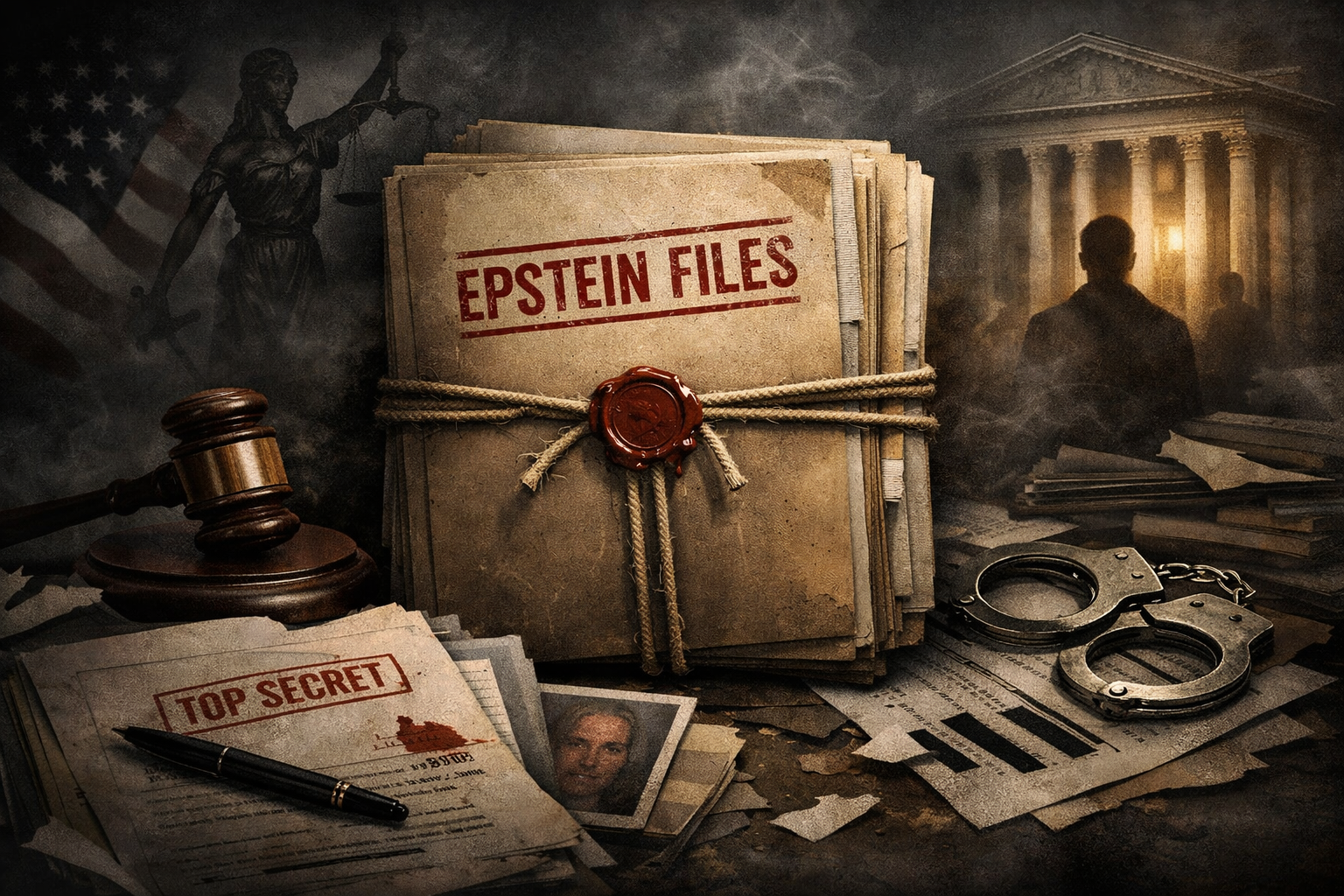
Following public and political pressure, US authorities released a limited set of Epstein-related documents.
What emerged was incomplete:
- Only a small fraction of total records were made public.
- Many documents were heavily redacted.
- Some materials included unverified claims and tip reports.
Authorities cautioned that not all documents reflect established facts. Many have never been tested in court.
What Remains Hidden
Hundreds of thousands of pages—possibly more—remain sealed. Officials cite privacy concerns, legal reviews, and national security considerations.
This leaves unresolved questions:
- Who else appears in these records?
- Who knew and failed to act?
- Why has full transparency been so difficult?
We explore similar accountability gaps in our analysis:
How Power Avoids Accountability.
Why the Epstein Case Still Matters
The Epstein case is not only about abuse. It is about systems—legal, political, and cultural—that respond differently when power is involved.
It shows how victims can be ignored, how justice can be delayed, and how truth can remain partial.
Until all relevant records are released and independently examined, the Epstein files will continue to represent something larger than one man: a test of whether accountability truly applies to everyone.
For our editorial standards and fact-checking approach, see:
Editorial Policy.
Disclaimer: This article is based on publicly available reporting, court records, and official statements. Mention of individuals does not imply guilt unless established by judicial findings.